



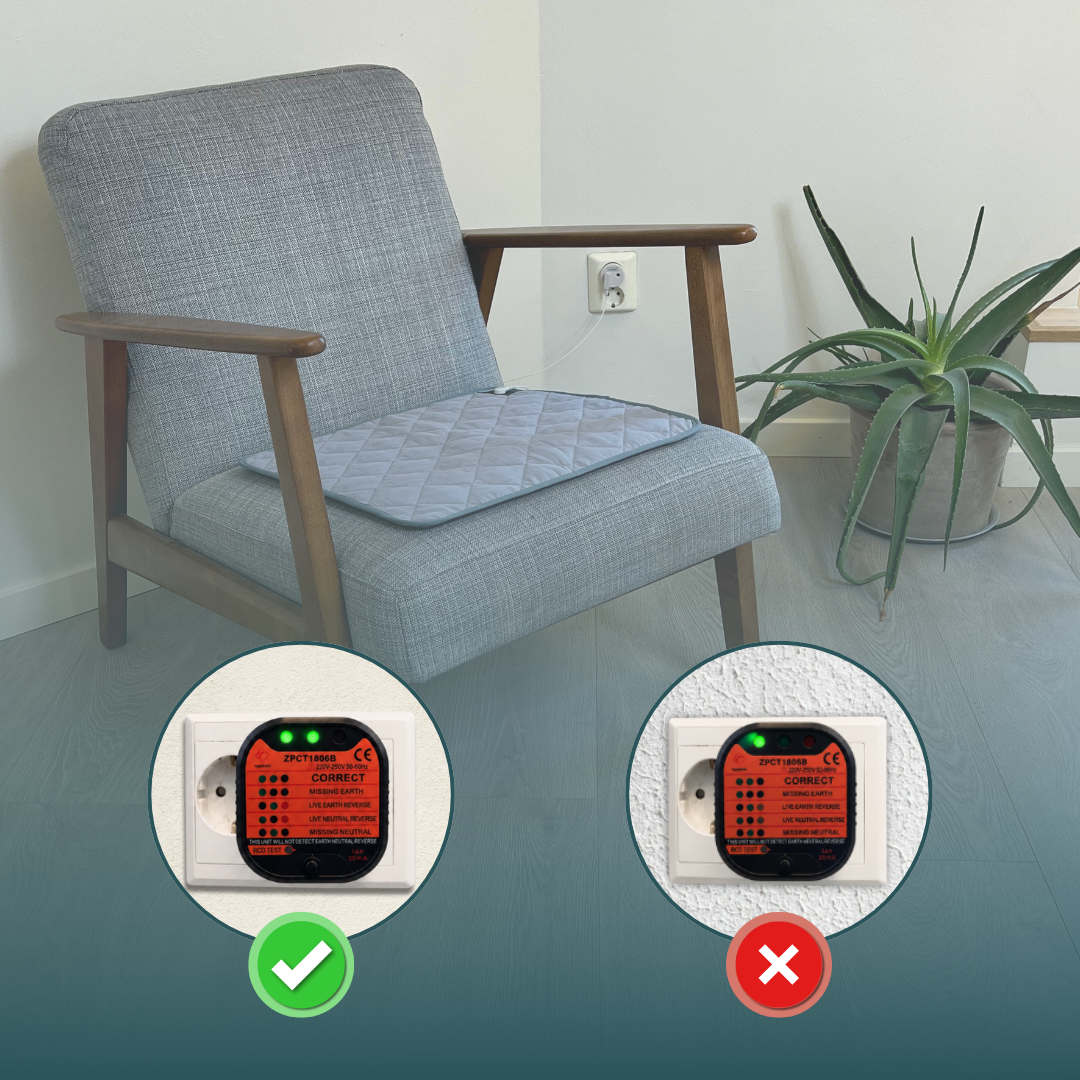
Before connecting an indoor grounding product, it is important to confirm that the outlet you plan to use is properly grounded.
Products such as a Grounding Bed Sheet, Grounding Bed Mat, Grounding Mat, or Grounding Pad rely on a functioning grounding connection to work as intended.
The easiest way to check is with a Grounding Socket Tester.
You do not need to open the outlet, use exposed wires, or perform electrical work yourself. A simple plug-in test can give you a quick indication of whether the outlet appears properly grounded.
Why Test the Outlet Before Grounding?
An electrical outlet can still power lamps, chargers, and other devices even if its grounding connection is missing or incorrectly wired.
That is why appearance alone is not enough.
A three-prong outlet may look suitable for grounding while still having an open ground or another wiring issue.
For indoor grounding products, the grounding pathway is the part that matters.
Grounding products do not use household electricity to power the product. Instead, the supplied grounding cord and plug connect to the grounded part of a compatible outlet.
Checking the outlet first removes one of the biggest sources of uncertainty from the setup.
 What Do You Need?
For a basic outlet check, use a Grounding Socket Tester designed for the outlet type in your country.
Grounding Essentials offers country-specific versions because electrical outlets differ between markets.
Before inserting the tester, take a quick look at the outlet.
Do not use an outlet if you notice:
-
Cracks or visible damage
-
Burn marks or discoloration
-
Unusual warmth
-
A loose receptacle
-
Buzzing or crackling
-
A burning smell
- Moisture around the outlet
If anything appears damaged or unusual, stop and have the outlet inspected by a qualified electrician.
How to Test a Grounded Outlet Step by Step
1. Test the Actual Outlet You Plan to Use
Use the Socket Tester in the same outlet that will be connected to your grounding product.
Do not assume that every outlet in the same room is wired identically.
This is especially useful when:
-
Setting up a grounding product for the first time
-
Moving it to another room
-
Moving into a new home
-
Staying in a hotel or holiday rental
- Using an outlet you have not checked before

2. Insert the Grounding Socket Tester
With dry hands, plug the tester directly into the outlet.
Make sure it is fully inserted.
There is no need to connect your Grounding Mat, Bed Sheet, or other grounding product yet.
3. Read the Indicator Lights
The tester uses LED indicator lights to show the outlet status.
Follow the guide supplied with the tester and compare the light pattern with the instructions.
With the current Grounding Essentials Socket Tester, a correctly grounded outlet is shown by the expected indicator pattern described in the product instructions. If the result indicates that the outlet is not properly grounded, do not connect your grounding product to it.
The tester is designed to identify common wiring conditions quickly, without requiring electrical knowledge.
4. Connect Your Grounding Product
Once the outlet shows the correct result, set up your grounding product according to its own instructions.
For example:
-
Fit a Grounding Bed Sheet over the mattress.
-
Secure a Grounding Bed Mat beneath a compatible fitted sheet.
-
Place a Grounding Mat where bare skin can comfortably make contact.
-
Position a Grounding Pad for sleeping, sitting, working, or relaxing.
- Use a Grounding Mouse Mat where your hand or wrist naturally rests while working.
The outlet test confirms the grounding connection. The individual product instructions determine how the product itself should be positioned and used.
What If the Tester Shows an Open Ground?
An open-ground result means the tester is not detecting the grounding pathway needed for your grounding setup.
Do not use that outlet.
Instead:
-
Try another outlet.
-
Test that outlet separately.
- If several outlets show the same problem, ask a qualified electrician to inspect the electrical system.
Do not attempt to create your own grounding connection using exposed wires, plumbing, radiators, screws, or unrelated household metal objects.
If your home does not have a suitable grounded outlet, Grounding Essentials also offers a Grounding Rod for compatible setups. Follow its specific installation instructions rather than improvising a connection.
What If the Tester Shows Another Fault?
A Socket Tester can also identify certain common wiring problems other than an open ground.
If the indicator pattern does not match the correct result, do not attempt to repair or alter the outlet yourself unless you are qualified to perform electrical work.
The safest options are to:
-
Use another verified outlet, or
- Have the outlet inspected professionally.
An outlet can appear normal and still have a wiring issue, which is exactly why testing it first is useful.

Socket Tester vs. Conductive Tester
These two Grounding Essentials testers have different purposes.
The Grounding Socket Tester checks the wall outlet.
The Grounding Conductive Tester checks the grounding product.
In simple terms:
Socket Tester = checks the outlet
Conductive Tester = checks the product
The Conductive Tester can be used with compatible products such as Grounding Bed Sheets, Half Sheets, Bed Mats, Grounding Mats, Pads, Mouse Mats, and Pillowcases. A green indicator confirms conductivity at the area being tested.
You do not need to run both tests every time you use your grounding setup.
Testing is most useful when setting up a product for the first time, moving to another outlet, troubleshooting, or checking conductivity after extended use or washing.
Do You Need a Multimeter?
For most users, no.
A plug-in Socket Tester is a simpler and more practical tool for checking whether an outlet appears properly grounded.
A multimeter can provide additional electrical measurements, but using one around energized outlets requires more knowledge and introduces unnecessary complexity for a basic grounding setup.
If a Socket Tester gives an unexpected result, use another outlet or contact a qualified electrician rather than attempting advanced electrical testing yourself.
Should You Test the Same Outlet Every Time?
Usually not.
If an outlet has already been verified and nothing about the electrical setup has changed, there is generally no need to test it before every grounding session.
Consider checking again when:
-
You move the product to another outlet
-
You move house
-
You travel
-
Electrical work has recently been completed
-
The outlet has become loose or damaged
-
You receive an unexpected result
- You suspect something about the wiring has changed
Once your home setup has been checked, grounding should remain straightforward.
What About Traveling With Grounding Products?
Travel is one situation where checking an outlet becomes especially useful.
Hotels, rental properties, and homes in other countries may use different outlet standards and wiring systems.
Use the correct Grounding Plug and Socket Tester for the country you are in.
Do not assume that a travel adapter creates a grounding connection. The underlying outlet still needs to be properly grounded.
This is especially useful if



Leave a comment
This site is protected by hCaptcha and the hCaptcha Privacy Policy and Terms of Service apply.