



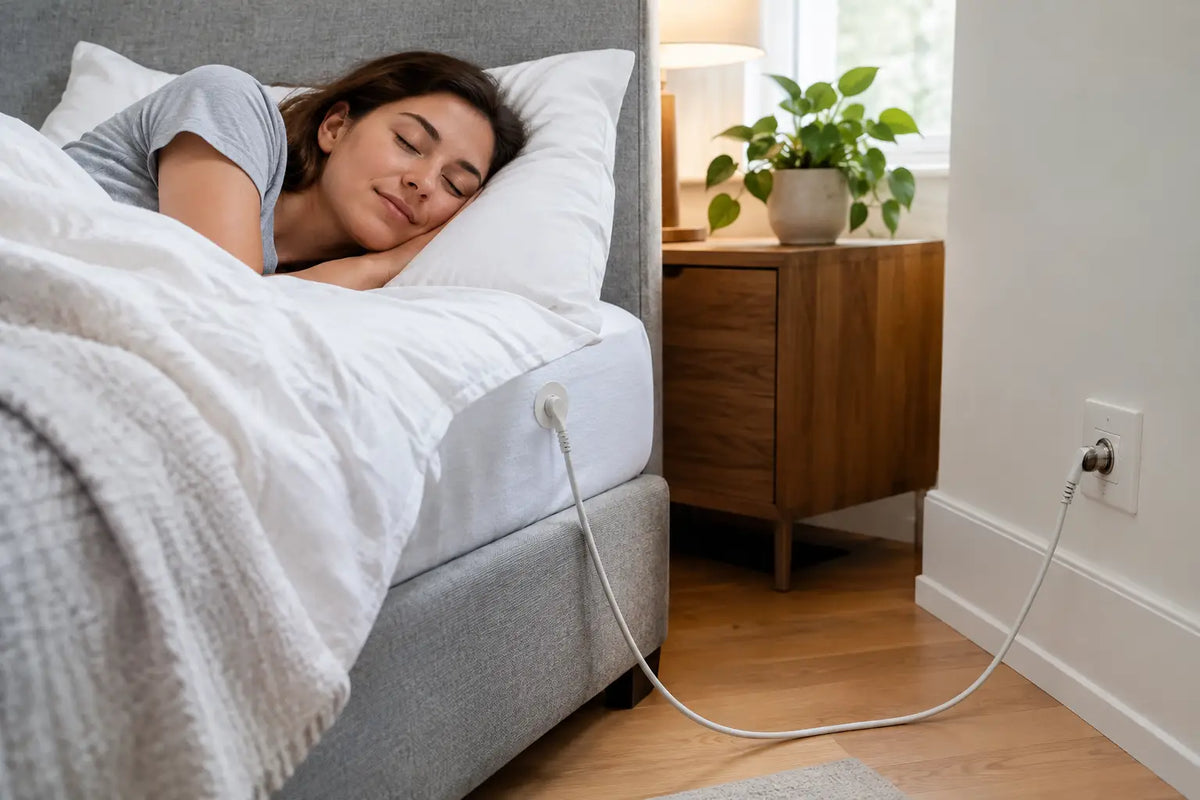
A grounding sheet, mat, or sleep pad is only as effective as its connection to the ground. That connection is the grounding cord. Understanding how grounding cords work can help you set up your product correctly, check that your outlet is suitable, and separate the practical science from exaggerated claims.
The short version is simple: a grounding cord connects conductive material in a grounding product to the grounding system in a properly wired electrical outlet. It does not plug you into household electricity or send power through your body. Its purpose is to provide a connection to the Earth’s electrical potential, similar to the connection you have when standing barefoot on conductive ground outdoors.
What a grounding cord actually does
A grounding cord is a low-voltage connection cable with two jobs. One end fastens to a grounding product, usually with a snap connector. The other end connects only to the ground port of a wall outlet or to a dedicated grounding stake when one is appropriate.
Inside a properly wired home, the ground port is connected to the building’s grounding system. That system is designed primarily for electrical safety: it provides a path for fault current to travel safely to ground rather than through a person or appliance. A grounding cord uses that existing ground connection as a reference point.
When your skin touches the conductive surface of a grounding sheet, mat, or pillowcase, the product may bring your body closer to the Earth’s electrical potential. Researchers sometimes measure this as a reduction in induced body voltage, particularly in indoor environments with electrical devices and wiring nearby. This is a measurable electrical effect, but it does not automatically prove a specific health outcome.
It is tempting to explain grounding as “electrons flowing into the body.” That is an oversimplification. Electrical charge can move to equalize differences in potential, but the amount, direction, and practical significance depend on the environment, the product, skin contact, humidity, and the electrical system itself. The most accurate description is that the cord creates a conductive path between the product and ground.
How grounding cords work with an outlet
In many grounded outlets, the round hole or U-shaped opening is the ground connection. The two flat slots are the live and neutral connections. A correctly designed grounding cord connects to the ground only. It should never be inserted into the live or neutral slots.
This distinction matters. Grounding products are not powered devices. They do not need electricity to work, and a grounding cord should not contain a transformer, battery, or active electrical component. If a product requires mains power to provide its grounding function, it is not operating in the usual earthing-product design.
A grounding cord also does not “absorb” electricity from your home. In a properly functioning setup, it connects a conductive product to the outlet’s safety-ground pathway. That pathway is normally separate from the current-carrying parts of the circuit.
Not every outlet has a usable ground, even if it looks like it does. Older buildings, damaged wiring, incorrectly installed outlets, and some adapters can leave the ground port disconnected or unreliable. This is why checking the outlet is one of the most useful setup steps you can take.
Grounded outlets vary by country
Outlet styles differ around the world, but the principle stays the same: the cord must connect to the protective earth or ground contact, not to an energized connection. Use the grounding cord and outlet adapter designed for your region. Avoid improvised adapters, altered plugs, or cords from unknown sources.
If you are unsure whether your outlet is grounded, a simple outlet tester can provide an initial check. A tester cannot diagnose every wiring fault, but it can identify common problems such as an open ground, reversed polarity, or an incorrectly wired outlet. If anything looks questionable, stop and ask a qualified electrician to inspect the outlet.
How the connection reaches your body
The cord alone does not create grounding. A complete setup has three parts: a verified ground source, an intact cord, and skin contact with a conductive product.
Grounding bed sheets often use conductive fibers woven through fabric. Mats and sleep pads typically use conductive carbon or silver-based materials. When bare skin touches the conductive section, the material can create an electrical connection between you and the cord. Thick clothing, nonconductive mattress protectors, plastic layers, or placing the product beneath several insulating layers can reduce or prevent that contact.
For sleep products, even modest contact can be enough to maintain a connection, such as a bare foot, leg, arm, or shoulder touching the sheet. You do not need to lie on a mat with your entire body exposed. The practical goal is comfortable, consistent skin contact while you sleep or rest.
Here is a straightforward way to set up a grounding product:
1. Check the outlet with a suitable outlet tester and use it only if the ground connection appears correct.
2. Attach the snap end of the cord firmly to the product’s connection point.
3. Insert the outlet end into the ground port as directed for your product and region.
4. Place the product so bare skin can touch its conductive surface comfortably and regularly.
Before using the product, inspect the cord for fraying, bent contacts, loose snaps, or damage. Replace a damaged cord rather than trying to repair it yourself.
What you may notice, and what research can tell us
People use grounding products for sleep, relaxation, recovery, and general wellbeing. Some customers report feeling more settled at night or noticing changes in sleep comfort over time. Those experiences are personal and can be meaningful, but they are not the same as clinical proof.
The research on grounding is still developing. Small studies have explored measures such as sleep, cortisol patterns, pain perception, blood flow, inflammation-related markers, and body voltage. Some findings are encouraging, but many studies are limited by small sample sizes, short duration, differences in design, and challenges with blinding. Larger, well-controlled independent studies are needed before strong health claims can be made.
That does not mean you need to dismiss grounding altogether. It means treating it as one supportive wellness practice among many. A grounding sleep setup may fit well beside a regular sleep schedule, a dark and cool bedroom, daytime movement, stress-management habits, and medical care when needed.
Results also vary. If you try grounding, give yourself enough time to assess it fairly, but avoid changing five other parts of your routine at once. Keep a simple note of your sleep schedule, wake-ups, comfort, and energy for a few weeks. This will give you a clearer picture than relying on a single unusually good or bad night.
Safety and setup mistakes to avoid
Grounding cords are designed for a specific purpose, and safety comes before convenience. Never connect a grounding product to a live electrical terminal, exposed wire, radiator, water pipe, or makeshift metal object. Do not use a cord that has been cut, modified, crushed under furniture, or exposed to moisture.
Do not assume every three-prong outlet is grounded. A tester is particularly worthwhile in older homes, rentals, and rooms where you do not know the electrical history. If an outlet tester indicates a fault, choose another verified outlet or contact an electrician. Do not try to bypass the problem with a cheater plug or extension setup that defeats the ground connection.
People with implanted medical devices or complex medical conditions should discuss new wellness products with their clinician if they have concerns. Grounding products are not medical devices and should not replace prescribed treatment, professional advice, or urgent care.
Choosing a cord that supports reliable use
A good grounding cord should be compatible with your product and region, long enough to reach the outlet without being stretched, and built with secure connectors. The cord should lie where it will not create a trip hazard or be repeatedly pulled by a bed frame, chair, or door.
For a sleep setup, route it along the side of the bed and leave enough slack for normal movement. Keep the connection accessible so you can inspect it occasionally. If you use a grounding sheet regularly, washing and care instructions matter too: conductive materials can lose performance when exposed to bleach, fabric softener, or overly harsh detergents.
Grounding Essentials products are designed to pair conductive surfaces with dedicated grounding cords and straightforward setup guidance. The most useful feature is not complexity. It is a reliable, verified connection that is easy to use night after night.
Start with the basics: verify the outlet, inspect the cord, create comfortable skin contact, and notice how the routine fits into your broader sleep and recovery habits. A grounding cord is a simple piece of equipment, but setting it up carefully gives you the best chance of evaluating the experience on its own terms.



Laisser un commentaire
Ce site est protégé par hCaptcha, et la Politique de confidentialité et les Conditions de service de hCaptcha s’appliquent.