



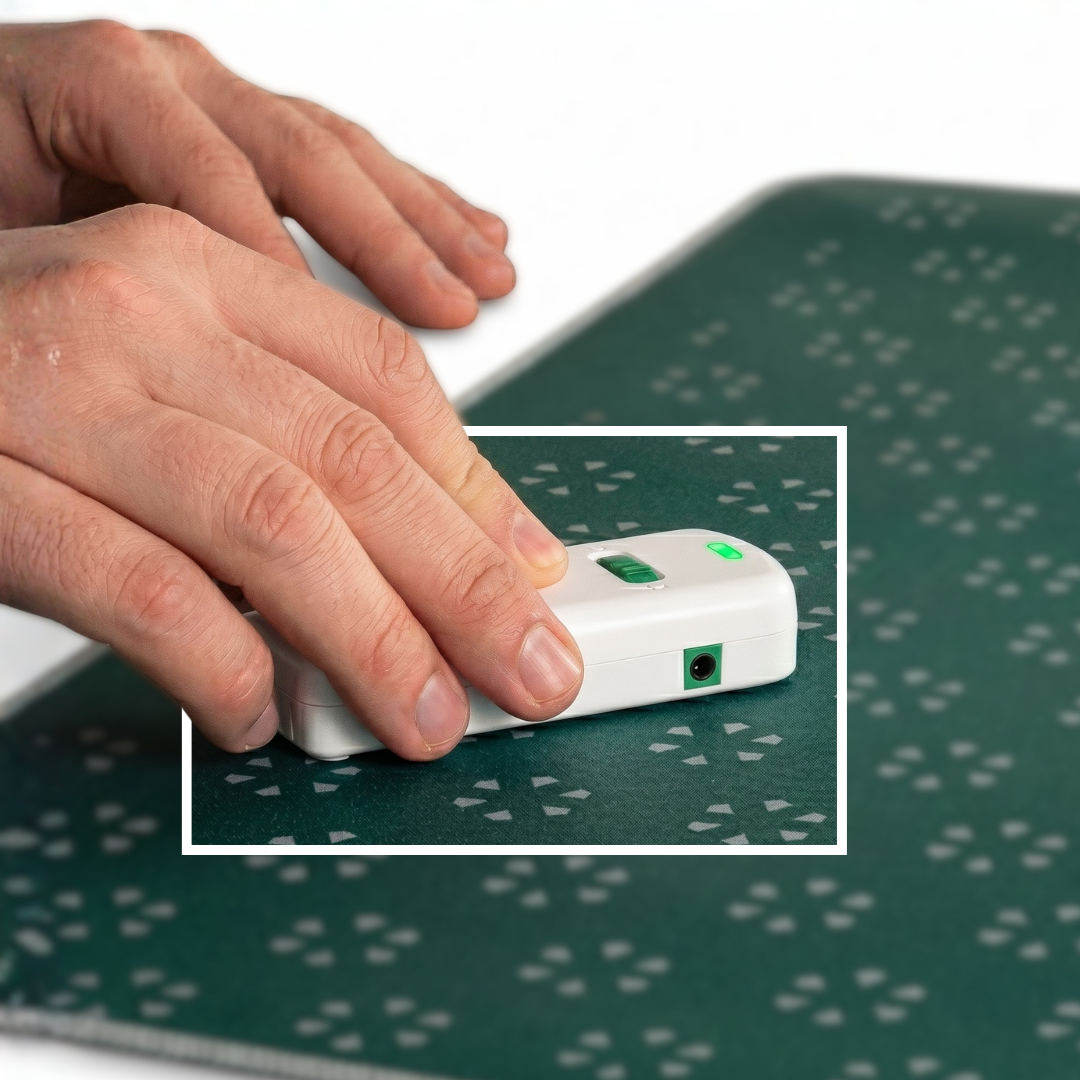
A grounding sheet can look perfectly fine while a loose connection, worn cord, or unsuitable outlet prevents your setup from working as intended. Learning how to use a Grounding Conductive Tester gives you a simple way to check your grounding product instead of guessing.
A Conductive Tester does not diagnose a health concern or prove that grounding will produce a particular wellness benefit. Its purpose is much simpler: it helps you check whether a compatible grounding product has a conductive surface and connection.
What Does a Grounding Conductive Tester Check?
A Grounding Conductive Tester is designed to check the conductivity of compatible grounding products.
At Grounding Essentials, it can be used with products such as:
- Grounding Bed Sheets
- Grounding Half Sheets
- Grounding Bed Mats
- Grounding Mats
- Grounding Pads
- Grounding Mouse Mats
- Grounding Pillowcases
The basic question is straightforward: is the grounding product conductive when it is connected correctly?
A successful test confirms conductivity at the area being tested. It does not measure how your body responds to grounding, nor does it prove a medical or wellness outcome.
This distinction matters. Grounding research has explored areas such as sleep, recovery, stress, inflammation, and body voltage, but the evidence is still developing. A Conductive Tester is a practical setup tool, not a medical device.

Conductive Tester vs. Socket Tester
One of the most important things to understand is that the Grounding Conductive Tester and Grounding Socket Tester perform different jobs.
Grounding Socket Tester
The Grounding Socket Tester checks whether the wall outlet you plan to use appears to be properly grounded.
This should be checked before connecting your grounding product.
Grounding Conductive Tester
The Grounding Conductive Tester checks the conductivity of the grounding product itself.
In simple terms:
- Socket Tester: checks the outlet
- Conductive Tester: checks the grounding product
Using one does not replace the other. A product may have a conductive surface even if the outlet it is connected to does not provide a proper grounding connection.
Grounding Essentials currently offers both tools separately for checking these different parts of a grounding setup.

Before You Use a Conductive Tester
Start by checking your grounding setup.
Look over the grounding product, cord, snap connector, and plug. Check for visible damage such as:
- Frayed or damaged cords
- Loose connectors
- Bent or damaged plugs
- Damaged product surfaces
- Corrosion or dirt around connection points
If a cord, connector, or plug is visibly damaged, stop using it and replace the damaged component rather than trying to work around the problem.
Next, check the outlet with a Grounding Socket Tester. A three-prong outlet does not automatically guarantee that its ground connection is functioning correctly.
If the Socket Tester indicates a wiring problem, do not use that outlet for grounding until it has been assessed by a qualified electrician.
Always follow the instructions supplied with your specific Grounding Essentials tester and product.
How to Use a Grounding Conductive Tester Step by Step
1. Check the Outlet First
Before testing your grounding product, use a Grounding Socket Tester to confirm that the outlet appears to be properly grounded.
If the outlet does not show the correct result, try another tested outlet or ask a qualified electrician to inspect the wiring.
Do not assume an outlet is grounded simply because it has a grounding port.
2. Set Up Your Grounding Product Normally
Position the product as you would normally use it.
For example:
- Fit a Grounding Bed Sheet over your mattress.
- Place a Grounding Bed Mat in the correct position beneath a compatible fitted sheet.
- Position a Grounding Mat or Pad where you normally use it.
- Set up your Grounding Mouse Mat beside your keyboard and mouse.
Connect the grounding cord securely to the product and then to the correct Grounding Plug.
3. Prepare the Conductive Tester
Turn on or prepare the Grounding Conductive Tester according to the instructions supplied with it.
Make sure the tester is functioning normally before testing the product. If the indicator is weak or inconsistent, check the tester and its battery before assuming there is a problem with your grounding product.
4. Test the Conductive Surface
Place the tester on the conductive area of the grounding product according to the supplied instructions.
Make good contact with the surface without scraping, puncturing, or applying unnecessary pressure.
When the tester indicates conductivity, it confirms that the area being tested is conductive.
Remember that this is a conductivity test. It does not indicate how strongly you are grounded or predict any health benefit.
5. Test Another Area
For larger products such as Grounding Bed Sheets or Bed Mats, it can be helpful to check more than one area.
This is particularly useful if:
- The product has been used for a long time
- A sheet has been washed many times
- You suspect one section is no longer conductive
- You are troubleshooting an inconsistent setup
Testing multiple areas gives you a clearer picture of the product's conductive surface.

What If the Conductive Tester Does Not Show a Positive Result?
A failed test does not automatically mean the entire grounding product needs to be replaced.
Work through the setup one part at a time.
Start by checking:
- Is the grounding cord connected securely?
- Is the snap or connector fully attached?
- Is the tester working correctly?
- Are you testing the correct conductive surface?
- Has the outlet been checked with a Grounding Socket Tester?
- Is the cord or product visibly damaged?
Reconnect the product and test again.
If possible, try another known grounded outlet after checking it with the Socket Tester. This can help determine whether the problem is related to the outlet or the product setup.
If you continue to receive an unexpected result, follow the troubleshooting instructions supplied with your Grounding Essentials product or contact customer support.
Why a Grounding Product May Lose Conductivity
Care and maintenance can affect conductive materials over time.
Grounding Bed Sheets, Half Sheets, and Pillowcases contain conductive fibers that require appropriate care. Body oils, lotions, detergent residue, fabric softener, bleach, and harsh cleaning products may affect conductivity or shorten the useful life of the material.
Follow the care instructions provided with each product.
For conductive textiles, avoid products or washing methods that may damage the conductive fibers.
For Grounding Mats, Bed Mats, Pads, and Mouse Mats, clean the surface according to the specific product instructions rather than using harsh cleaning products.
Cords should also be treated carefully. Avoid sharply folding them, trapping them under furniture, pulling on connectors, or placing them where they may be damaged.

When Should You Test Your Grounding Product?
You do not necessarily need to test your product before every use.
A periodic check can be helpful, particularly:
- When setting up a new grounding product
- After moving to a new home
- When changing the outlet you use
- After replacing a cord or plug
- After a grounding textile has been washed repeatedly
- If you suspect your setup is no longer working as expected
Testing after a significant change can help you identify problems before spending weeks wondering whether your setup is functioning correctly.
Conductivity Is Only One Part of Proper Grounding
A Conductive Tester confirms an important technical part of your setup, but correct use still matters.
Make sure your grounding product is connected to a properly grounded outlet and positioned so that suitable contact can occur.
For a Grounding Mat, Pad, or Mouse Mat, direct contact with bare skin generally provides the clearest conductive connection.
For a Grounding Bed Sheet, Half Sheet, or Pillowcase, direct skin contact with the conductive fabric is recommended.
A Grounding Bed Mat can be positioned beneath a compatible fitted sheet. Thin natural fabrics such as cotton or linen are generally preferable to thick, synthetic, waterproof, or heavily treated layers that may reduce conductivity.
Grounding should also be viewed as a wellness practice rather than a replacement for medical treatment. Individual experiences vary, and current research is still developing.



Leave a comment
This site is protected by hCaptcha and the hCaptcha Privacy Policy and Terms of Service apply.